
industry insights
Poseidon Nickel and Windarra: Iconic Australian Mine Sites #7
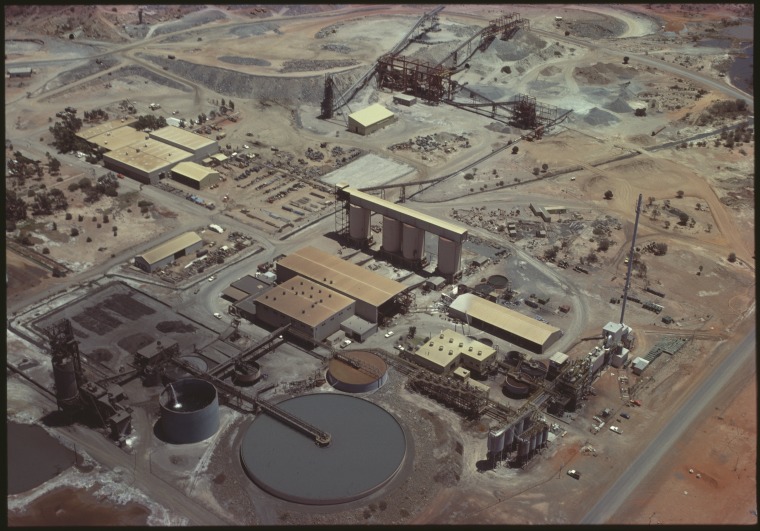
Windarra Nickel Project, 8 November 1983. State Library of Western Australia, 149272PD.
Iconic Australian Mine Sites · Episode #7
The discovery that gripped Australia, the mine behind the headlines and a new chapter in gold.
Few names in Australian mining carry the recognition of Poseidon. A nickel discovery near Laverton in 1969 sent a small exploration company into the centre of a share-market frenzy, with its shares climbing from around 80 cents to an intraday peak of $280 in February 1970. 1, 2
Behind that extraordinary rise was Windarra, a real deposit that became a working mine and helped reshape a Goldfields community. Its story continued long after the speculative boom had faded.
For episode #7 of Iconic Australian Mine Sites, we head to Western Australia’s northern Goldfields to explore the discovery, the people who built the operation and the new plans to recover gold from its historic tailings.
In this article: Discovery · Boom and bust · Timeline · Operations · Innovation · The future · Community
Discovery and Founding
The Windarra story begins with prospector Ken Shirley, whose working life had taken him through fencing, shepherding, opal mining and gold prospecting before the search for nickel brought him back to Western Australia. He was contracted to prospect for Poseidon in 1968 and identified the nickel occurrence at Mount Windarra, roughly 25 kilometres north-west of Laverton, in 1969. 3
The timing helped turn a discovery into a sensation. Nickel supplies were tight, demand was strong and industrial action at Canadian producer Inco had added pressure to the market. Poseidon announced preliminary drilling results on 29 September 1969, followed by a more detailed announcement on 1 October. 1
The Boom and Bust That Made Poseidon Famous
Windarra became a household name before it became a producing mine. Its discovery offered a compelling story at a time when investors were looking for the next big resources success. The speed of the share-price rise then became part of the attraction itself.
From around 80 cents in early September 1969, Poseidon reached an intraday high of $280 on 5 February 1970, roughly 350 times its earlier price. ASIC puts its peak market value at about one-third of BHP’s. 1, 2
The buying spread to other nickel explorers, companies holding nearby leases and mining shares more broadly. New floats attracted money even when they had little established behind them. The market was increasingly trading on expectation, with limited reliable information about what could actually be mined. 1
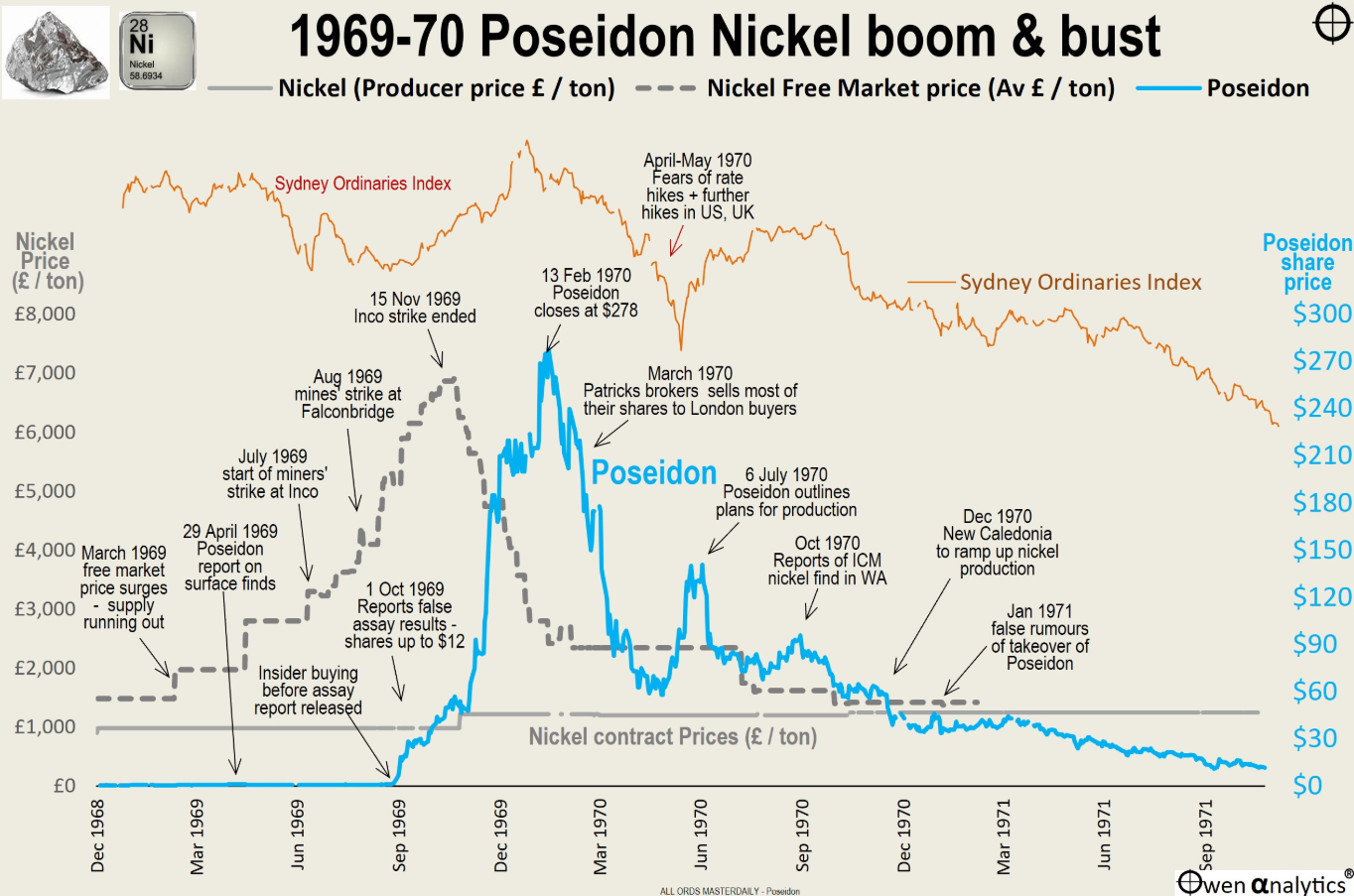
Poseidon’s share price, nickel prices and the broader market during the boom and bust. Chart: Ashley Owen / Owen Analytics.
The chart marks the highest closing price, $278 on 13 February 1970. The $280 figure in this article is the intraday high on 5 February. Nickel prices use the chart’s historical pounds-per-ton scale; shares use Australian dollars. 1, 14
There were serious problems behind the promotion. ASIC’s account describes incomplete and inaccurate geological reporting, rumours and insider trading across the boom. Investors were making decisions in a market where the quality of information and the interests behind it were often difficult to judge. 2
The nickel shortage also eased. After the Canadian strike ended in November 1969, free-market nickel prices fell, while Poseidon shares continued climbing into February. That divergence helps explain how speculation outlasted the supply squeeze that had helped start it. 14
The reversal was severe. Poseidon shares collapsed during 1970 and continued falling into 1971. The RBA’s historical review does not identify a single clear trigger for the crash. Across the sector, the All Mining Index fell from above 640 in January 1970 to around 200 by November 1971. 1, 14
For investors who bought near the peak, a genuine nickel discovery offered little protection from an inflated purchase price. Meanwhile, the task of financing, building and operating Windarra still lay ahead. Production only began in 1974. 4
The aftermath also changed the industry. The 1974 Rae Committee report exposed failures in market oversight and disclosure. ASIC links the episode to the push for stronger mineral-reporting guidelines and, ultimately, the JORC Code. 1, 2
That is why Poseidon remains such a useful mining story. A discovery can be real and still carry expectations that its eventual operation cannot meet. The workforce, infrastructure and economics have to deliver what the market has already priced in.
Development Timeline
Turning the discovery into an operation required processing infrastructure, reliable water, transport and a workforce. The development continued through falling nickel prices and growing financial pressure. Key milestones were: 1, 4
-
1969: The Mount Windarra discovery brought Poseidon to national and international attention.
-
1972: Western Mining Corporation acquired a 50 per cent interest in the Windarra project.
-
1974: Nickel production began, several years after the share-price peak.
-
1975–1977: WMC took over project management, Poseidon entered receivership and its half-share in the project was subsequently sold to Shell.
-
1978–1981: Weak market conditions brought a suspension, followed by a return to mining.
-
1990–1994: Mount Windarra mining ended in 1990 and South Windarra followed in 1991. Processing continued until 1994.
The mining asset and the fortunes of the company that discovered it followed different paths. Windarra continued operating under WMC long after the original Poseidon boom had collapsed.
Output and Scale
Windarra was a connected mining and processing operation built around Mount Windarra and South Windarra. Poseidon’s 2010 report placed the deposits about 18 kilometres apart along the nickel-bearing belt. Mount Windarra supplied underground ore, while South Windarra’s open pit became another important part of the project. 6, 8
Working underground
At Mount Windarra, the original decline carried both people and ore. A vertical haulage shaft was later added, with ore crushed underground and raised in five-tonne skips. WMC’s heritage material records approximately 47 kilometres of workings. Poseidon’s later reporting put the historic mining depth at about 550 metres. 6, 9
The geology made that work demanding. A 1985 AusIMM paper described seven steep ore shoots and difficult ground conditions, including cleaved rock and serpentinite. Longhole open stoping with backfill had been the main mining method, but its poor performance had brought the operation close to closure in 1984. 10
That detail adds something the share-market story often misses. The operation’s success depended on how safely and efficiently crews could develop access, support the ground and extract the ore. Grade alone did not determine whether a section of the mine could be worked economically.
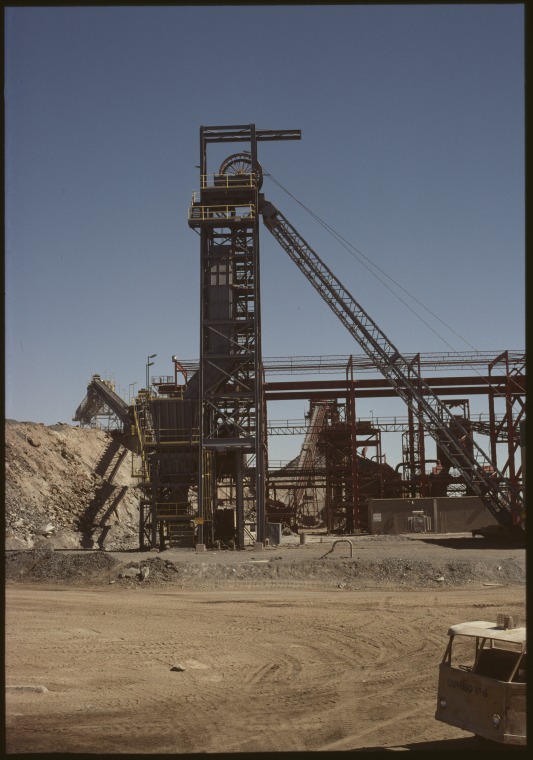
The haulage shaft at Windarra, 8 November 1983. State Library of Western Australia, 149305PD.
From ore to concentrate
The surface plant brought together crushing, conveyors, fine-ore storage, ball milling, flotation and thickening. This sequence reduced the rock and separated a nickel-rich concentrate from the remaining material. 9
Finding adequate water locally allowed processing to take place at Windarra, avoiding the need to move bulk ore to Kalgoorlie. The surviving crusher, ore-bin and mill foundations help explain how much infrastructure was needed around the underground workings. 5
Keeping this system running required maintenance across the whole operation. A stoppage at the hoist, crusher, mill or pumping system could affect the next stage. For the workforce, mining, processing and maintenance were closely connected jobs.
Production and infrastructure
WMC’s heritage brochure records 5.3 million tonnes of ore extracted from Mount Windarra at an average grade of 1.5 per cent nickel. Across its operating life, the plant treated more than 14 million tonnes, including feed from South Windarra and gold ore from Lancefield and Beasley Creek. These are different measures: Mount Windarra mine output and total plant throughput. 9
A 20 MW power station supplied the operation, South Windarra, the village and Laverton. Mine services included continuous pumping and ventilation. 9
The gold connection helps explain the site’s present-day direction. Windarra’s processing history left both nickel and gold-bearing tailings. Poseidon’s 2024 agreement with Encore identified both as potential sources of value, subject to further assessment. 13
Innovation
Windarra’s later exploration programmes show how a familiar mining district can be reconsidered as knowledge improves. Poseidon’s 2007 reporting described the use of modern three-dimensional modelling and down-hole electromagnetic surveys to help target nickel-bearing lava channels. 7
These methods gave geologists another way to investigate ground around existing drill holes and reinterpret historical information. An old mining area could still offer new targets, provided the geological evidence supported them.
The discovery of Cerberus in 2008 gave the later Poseidon Nickel company another deposit to assess alongside Mount Windarra. The company described the wider project as a 24-kilometre ultramafic belt, with nickel sulphides associated with ancient lava channels. 6
There was also substantial work below ground. By December 2012, refurbishment had reached 400 metres vertically below surface, approximately 3.6 kilometres along the decline. Power and water services had been extended to the old underground crusher area, allowing exploration drilling from within the mine. 11
The redevelopment concept paired Mount Windarra with Cerberus, around 10 kilometres away, feeding a proposed new flotation concentrator with a minimum capacity of 700,000 tonnes a year. The plan also included gold-tailings retreatment and tailings placement at South Windarra. These were development proposals, rather than recorded production from a restarted operation. 11
The distinction matters. Dewatering, restoring access, drilling and completing a feasibility study are substantial tasks, but a return to production also requires finance, approvals, processing capacity and a market for the product.
The Future
The Poseidon name returned to Windarra through a later corporate chapter: Niagara Mining adopted the Poseidon Nickel name in 2007. It should be distinguished from the original company behind the 1969 boom. 7
On 7 September 2026, Encore Minerals announced approval to develop the Windarra Tailings Project with Poseidon Nickel Pty Ltd, now a wholly owned subsidiary of Maritana Minerals. Encore said its investment decision followed an updated feasibility study and was made in June 2026. 8
The proposed operation will re-mine historic tailings, recover gold using Draslovka’s GlyCat technology and place the treated material into the mined-out South Windarra pit. Encore identified sealed roads, water, offices and accommodation among the existing infrastructure supporting development. First production is expected in mid-2027. 8
For scale, Poseidon’s earlier 2021 study assessed a 1.5-million-tonne-a-year plant and forecast roughly 53,500–55,200 ounces of gold over 45 months, depending on the mining method. Those figures describe the earlier study, not confirmed output or the final design of Encore’s updated project. 12
The current development announcement concerns gold recovery from tailings. It does not establish that Mount Windarra’s underground nickel mine has restarted. 8
For me, that makes Windarra particularly interesting to revisit. New processing methods can prompt a fresh assessment of material left by an earlier generation of mining. The next chapter may be built around what remains above ground.
Community and Legacy
The share-price story is famous. The community story deserves just as much attention.
Windarra’s original village included a shop, post office and swimming pool, with accommodation for up to 400 people at one stage. Families were later housed in Laverton, while the village served single workers. The heritage record links the project directly to Laverton’s redevelopment. 5
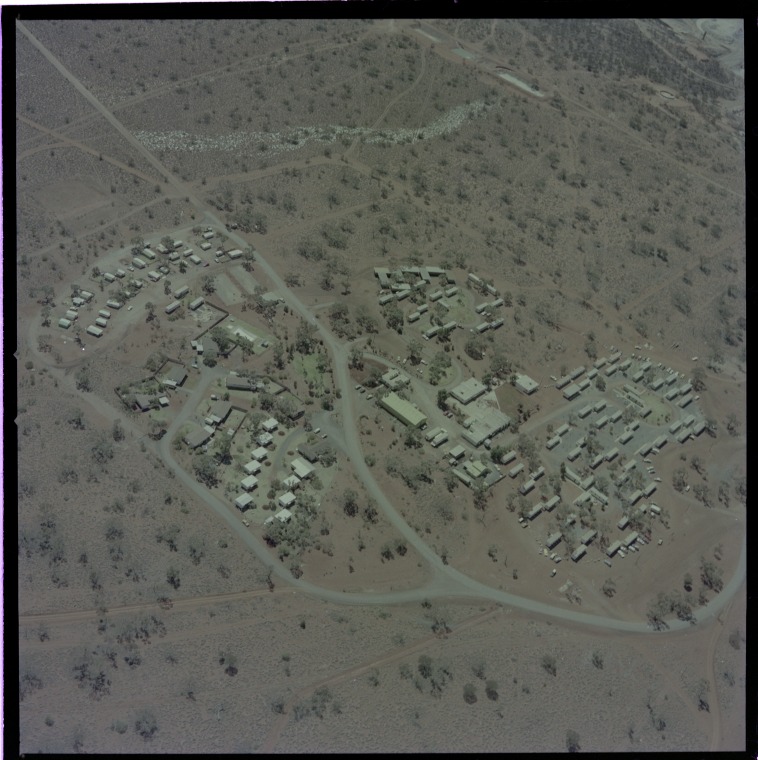
Windarra miners’ camp, 14 September 1977. State Library of Western Australia, 328332PD.
Behind that accommodation figure were workers and families building their lives around the mine. It meant decisions about where to settle, children enrolling in school and a town growing and adapting alongside the operation.
That community connection continued into rehabilitation. After the processing plant was decommissioned, work included collecting and sowing local native seed. Laverton schoolchildren also planted trees, helping shape the future of a site that had shaped their town. 5
As a mining recruiter, this part of Windarra’s story resonates with me. Exploration, construction, operations, maintenance and closure each require different skills and experience. Moving between those stages has consequences for people too: their employment, their families and whether they can continue living in the community they call home.
For me, Windarra reinforces the importance of planning for people throughout a mine’s life. That means thinking carefully about the workforce needed to deliver a project and what comes next for those workers when the operation changes or closes.
Conclusion
Windarra captures a remarkable chapter in Australian mining: a significant nickel discovery, extraordinary speculation and the hard work of turning an orebody into an operating mine. At the heart of that story are the people who built it, worked there and made a life in the surrounding community.
Its history remains relevant today. A discovery can attract attention and investment, but lasting value depends on sound geology, workable economics, reliable infrastructure and capable people. The real test comes when expectations meet the realities of mining.
With gold tailings treatment offering the possibility of another chapter, I think Windarra deserves to be remembered for the full story. The Poseidon boom secured its place in share market history. The decades of work that followed secured its place in Western Australia’s mining heritage.
Did you work at Windarra, live in Laverton during its operating years, or grow up hearing the Poseidon story from someone who was there? I’d welcome your memories through our contact page. Which iconic Australian mine site should we explore next?
Planning your next move in mining?
Hill Work Skills Australia offers practical support with mining resumes, interview preparation and career planning. Explore the services available or get in touch to discuss your next step.
Explore more Australian mining stories
- Explore the Iconic Australian Mine Sites collection
- Super Pit, Kalgoorlie
- Tropicana Gold Mine
- What mining recruiters look for in a resume
- How to get into mining with no experience
Sources
Source links support the article’s historical facts and dated project update. Forecast timing is attributed to the project developer.
-
Reserve Bank of Australia | John Simon, Three Australian Asset-price Bubbles, 2003, section 4
-
ASIC | John Price, ASIC’s perspective on resources and reserves reporting, 29 April 2013, pages 2–3
-
State Library of Western Australia | Ken Shirley, Mining and Energy Western Australia exhibition
-
Windarra Nickel Mine | Historical chronology citing Gilbert M Ralph’s WMC histories of 1994 and 2005
-
Shire of Laverton / inHerit | Windarra Heritage Trail, place 02696
-
Poseidon Nickel | Quarterly Report for the period ending 30 June 2007, released 31 July 2007
-
Poseidon Nickel | Windarra Gold Tailings Feasibility Study Highlights Robust Project, 23 July 2021
-
Poseidon Nickel | Agreement with Encore Minerals to Develop Windarra Tailings Project, 31 July 2024